Composite Score: 24/30
Average Result: BBS-/DFS+
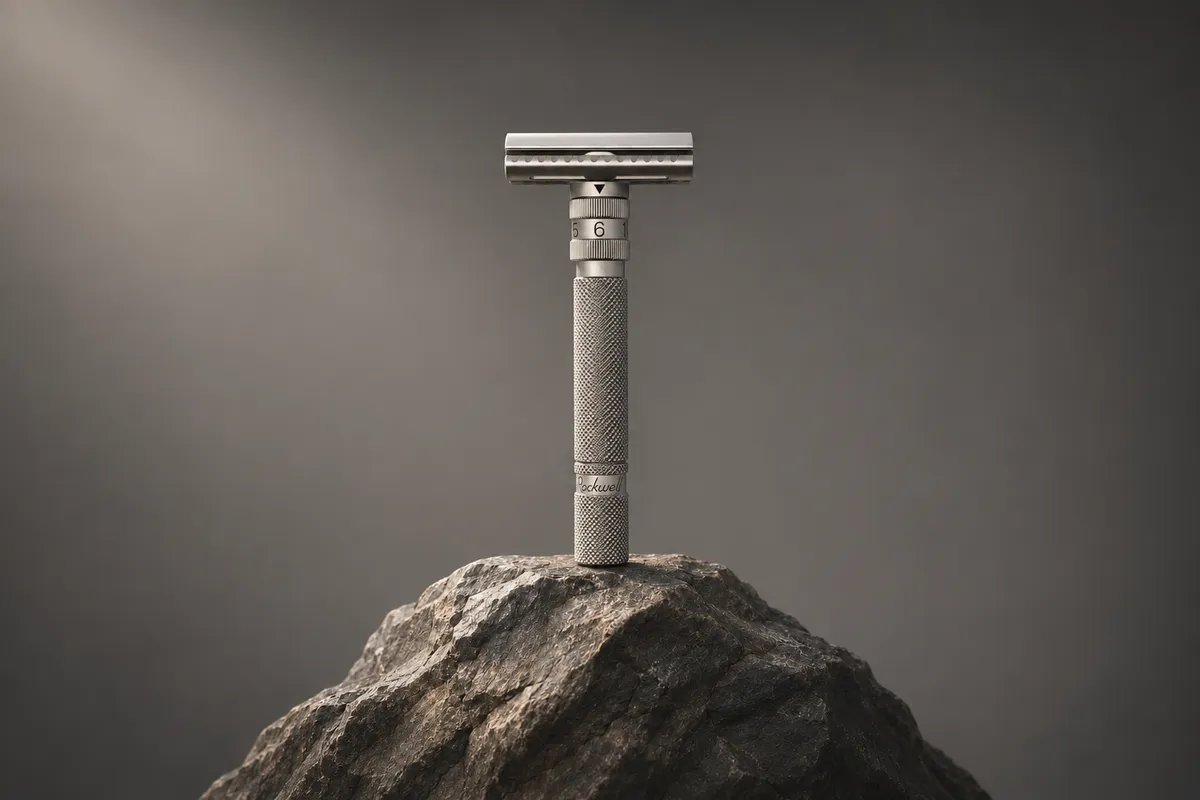
The Rockwell Setpoint was four years in development and represents the technological successor to the innovative T2, an adjustable butterfly razor introduced in 2021. The Setpoint bears a striking resemblance to the Merkur Progress, particularly in its head geometry. Like the Progress, the Setpoint is a two piece razor, but whereas the Progress adjusts through a knob at the bottom of the handle, the Setpoint employs a more traditional adjustment collar reminiscent of early Gillette adjustables such as the Toggle and Fatboy. The Setpoint offers six adjustment levels spanning a blade gap of 0.3mm to 1.1mm, compared with the Progress's five nominal levels and a gap range of approximately 0.38mm to 0.94mm.


Left: Progress, Right: Setpoint
The Setpoint is offered in both aluminum, weighing a svelte 42g, and stainless steel, at a substantial but manageable 115g. ShaveSplash opted for the stainless steel version, as our testing has generally found that additional mass contributes to a smoother cutting action by helping maintain a stable shave plane against the skin.
At first glance, the Setpoint impresses with its build quality and feels lovely in the hand. The satin finish is attractive, while the deep, evenly distributed knurling provides excellent grip. Unlike some adjustables whose mechanisms can feel stiff or imprecise, the Setpoint's adjustment collar operates with surprising ease, turning smoothly and effortlessly between settings.
Unfortunately, despite its impressive construction, the Setpoint suffers from several design choices that ultimately compromise its performance.
ShaveSplash began testing at level 6, where the 1.1mm blade gap falls comfortably within the range of modern safety razors, which commonly span from approximately 0.7mm, as found on the Alpha Outlaw Evolution, to 1.2mm on the Blutt BR-1.
At this setting, the Setpoint immediately exhibited considerable chatter, skipping across the skin and causing irritation and skin damage. Interestingly, the culprit was not inadequate blade clamping. The Setpoint features a generous 18mm clamp width, comparable to several high performing Edge Clampers, including the Karve Overlander, Carbon CX, and Wolfman WR1 and WR2.
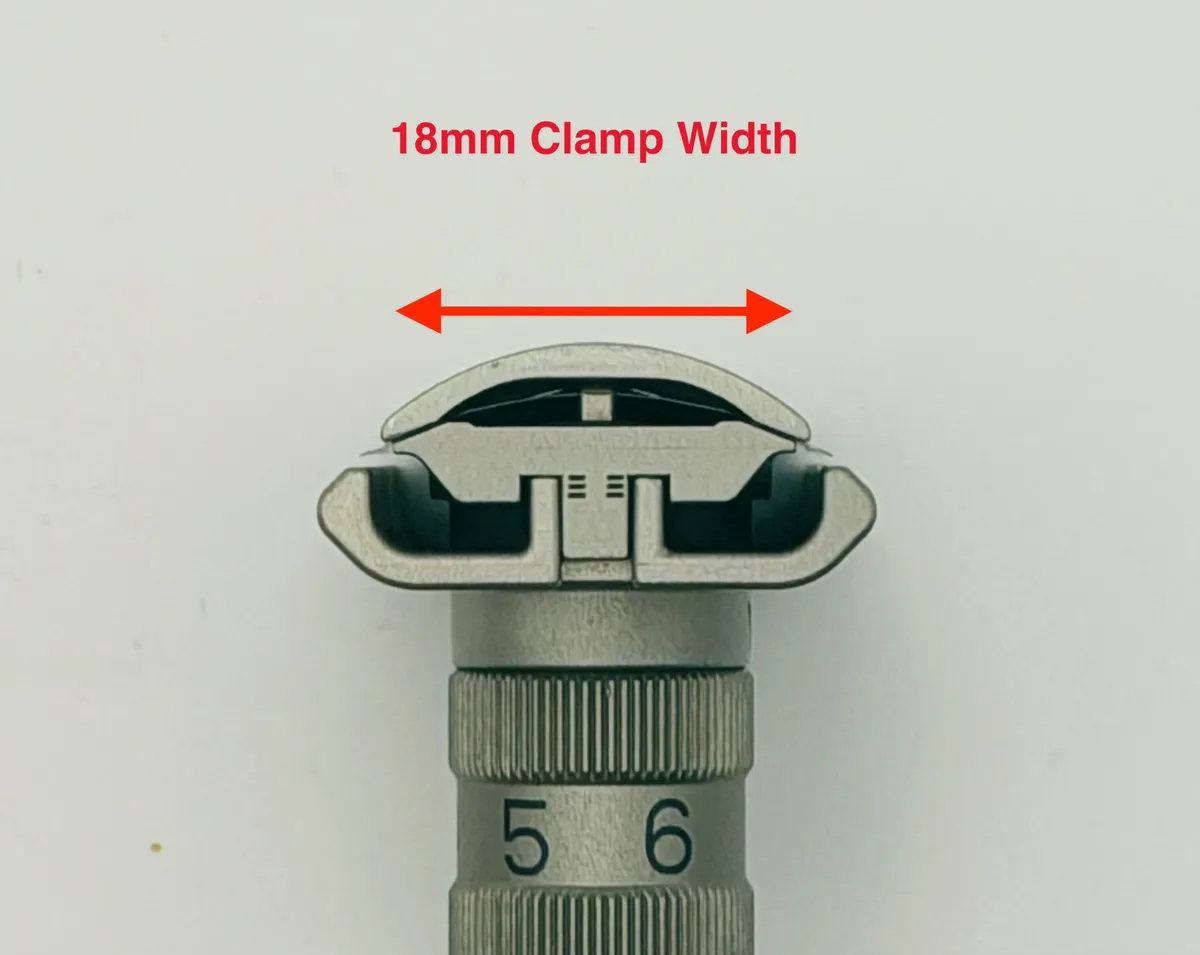
Instead, the chatter appeared to originate from a phenomenon ShaveSplash had not previously encountered: vertical movement of the base plate itself.
Unlike adjustables such as the Osprey or Fatboy, whose base plates remain firmly positioned at their selected settings, the Setpoint's lower base plate is supported by a mechanism that allows it to compress under pressure. Even modest pressure produces noticeable movement, while greater force can compress the plate through virtually the entire 0.8mm adjustment range, from the 1.1mm gap at level 6 to the 0.3mm gap at level 1.
This is a particularly consequential design characteristic.
Although the blade itself is securely clamped across 18mm between the top cap and underlying central plate, the safety bar is attached to the movable lower base plate. As a result, its movement introduces continuous changes to the relationship between the blade and the skin. Blade gap, effective exposure, shaving angle, and guard span are no longer held in a fixed geometric relationship throughout the shave.
This fluidity runs counter to one of the central principles of the ShaveSplash methodology: that stability and rigidity are fundamental to consistent razor performance. A firmly clamped blade is only part of the equation. The surrounding head geometry must also remain stable to maintain a predictable cutting action.
In the Setpoint, movement of the safety bar alters the way the blade engages the skin, producing an irregular cutting sensation that effectively mimics some of the undesirable effects of blade flex. The result is chatter, diminished consistency, and increased irritation, despite the blade itself being securely clamped.
Compounding the problem is the Setpoint's unusually wide guard span. At level 6, ShaveSplash measured a guard span of 2.5mm, considerably greater than that of several comparable razors. For perspective, the Carbon CX with its ++ plate has a 1.08mm blade gap and a guard span of just 1.6mm, while the Wolfman WR2 with a 1.15mm gap has a guard span of 2.0mm.
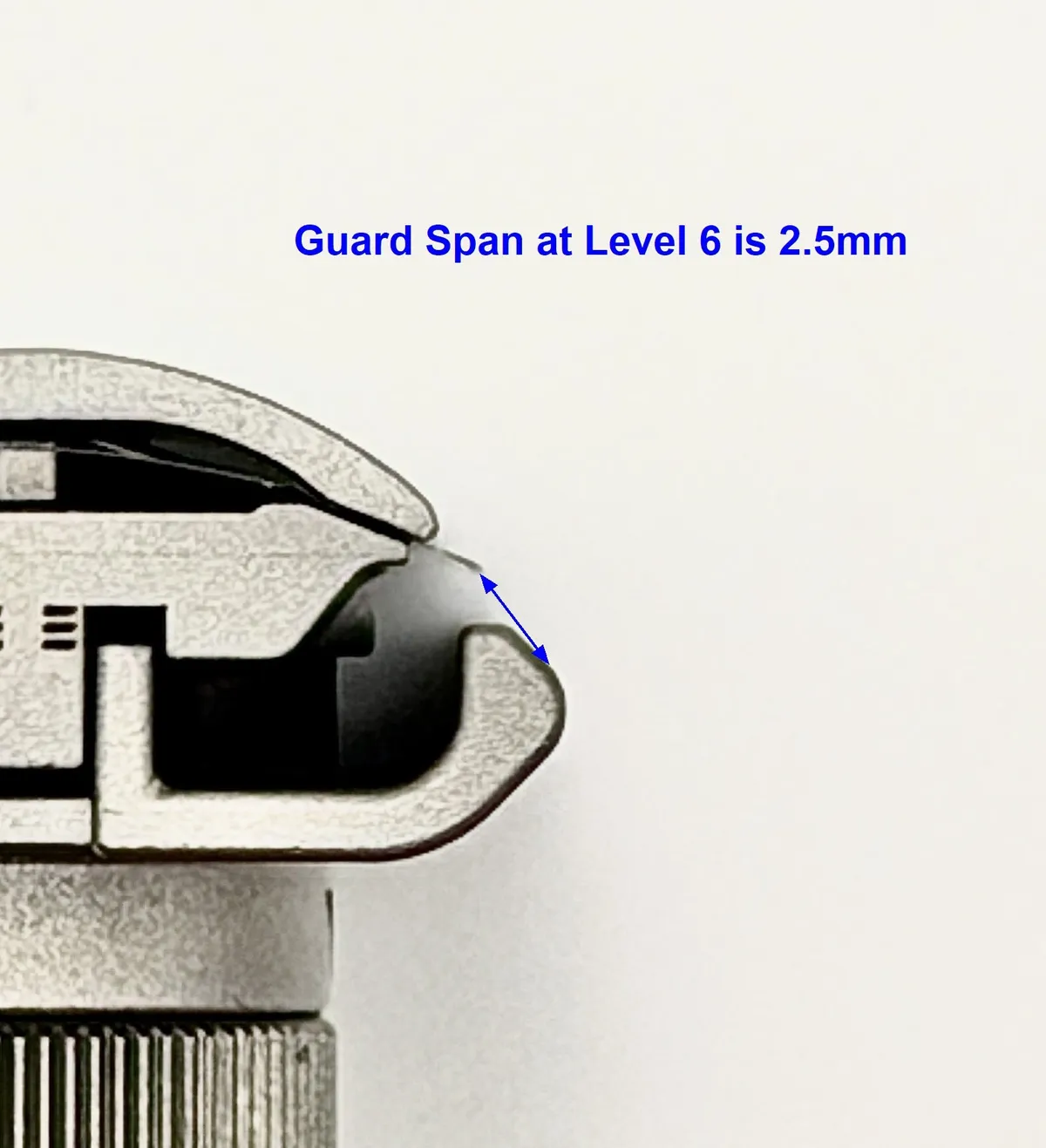
The Setpoint's wider guard span has the unfortunate effect of amplifying the consequences of safety bar movement, further undermining stability and comfort.
At lower settings, this behavior becomes progressively less pronounced as both blade gap and guard span diminish. By level 1, the guard span contracts to just 0.8mm, while the blade gap narrows to 0.3mm. At this setting, movement of the base plate becomes almost imperceptible during shaving, although efficiency is correspondingly very low.
Interestingly, reports from the shaving community suggest that the aluminum Setpoint delivers greater comfort than its stainless steel counterpart. One possible explanation is its substantially lower mass, which may reduce the forces acting on the movable base plate and safety bar during shaving. While ShaveSplash has not tested the aluminum version, the observation is consistent with the behavior experienced during our evaluation.
To preserve reasonable comfort, ShaveSplash ultimately restricted testing to settings below level 4. Even at these more conservative settings, however, performance remained middling. The Setpoint earned an Efficiency score of 5, Comfort of 6, Ease of Use of 7, and Consistency of 6, producing a composite score of 24 and a shaving result of BBS-/DFS+.
Adjustable razors occupy a distinct place in traditional wet shaving, both in their engineering and in the way they are used. For many enthusiasts, they represent an ideal solution, combining versatility, convenience, and value by offering multiple shaving characteristics in a single instrument.
Although ShaveSplash's experience with adjustable razors remains somewhat limited, examples such as the Osprey and Gillette Fatboy demonstrate that adjustability need not come at the expense of stability or comfort. Both offer comparable versatility while delivering superior performance, particularly in Comfort.
The Rockwell Setpoint is undeniably an attractive, beautifully finished razor with excellent ergonomics and a pleasing adjustment mechanism. Unfortunately, its unusual base plate design introduces a degree of instability that undermines the very qualities its otherwise thoughtful engineering seeks to deliver. For ShaveSplash, these shortcomings are simply too significant to overlook.


Comments
Loading comments…