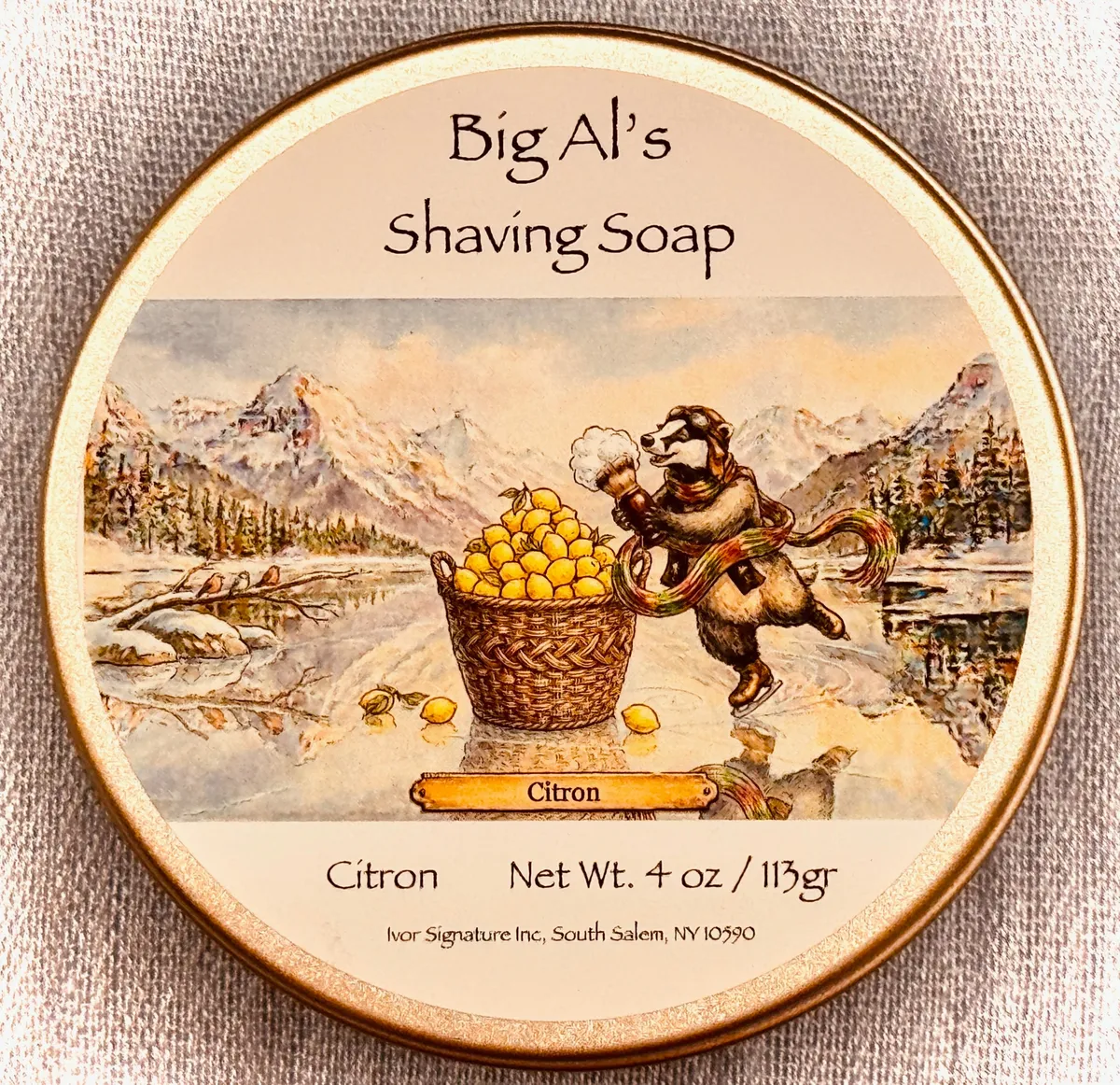
Mark Albert, the founder of Big Al’s Shaving, like so many of us who stumbled into the world of traditional wet shaving, quickly fell in love with the hobby, then felt the urge to make his own mark. But beyond the passion so many of us share, Mark brings a keenly analytical mind, an insatiable curiosity about the science of grooming, and the creativity and determination to turn his ideas into something truly his own.
What began as a simple experiment in soapmaking has evolved into a growing collection of shaving soaps, pre-shaves, balms, and other grooming products, each reflecting Mark’s relentless pursuit of performance, quality, and originality. His approach is as much about understanding the chemistry behind exceptional products as it is about celebrating the pleasure and artistry of traditional wet shaving.
Big Al’s Shaving is a young venture, its flame only beginning to catch. Yet it already exhibits the unmistakable hallmarks of an artisan with something special to offer: thoughtful formulations, distinctive character, a playful spirit, and an uncompromising commitment to quality. ShaveSplash had the pleasure of sampling Mark’s shaving soap and pre-shave early on, and we quickly became admirers of both his products and the philosophy behind them.
We wanted to give Mark an opportunity to share his journey, his discoveries, and his vision for what promises to be a wonderful new addition to the artisan wet shaving community.
Here’s Mark, in his own words…
How did you first discover traditional wet shaving, and what sparked your passion for it? Was there a particular experience or product that drew you in?
I supposed I’ve always liked nice things. When I started shaving (about 45 years ago), I was surprised at the fact that there were so few high-quality razors in the world, despite the fact that most of the world’s population shaved. Every year or so, I would look to see what the latest and greatest razor and blade was - always ending up buying the latest variation of a Gillette cartridge device. Later, as a young adult, I walked into an Art of Shaving store and purchased a Silvertip Badger brush and some Sandalwood shaving cream. That was the beginning of the end. A few year’s back, I saw an add for a Henson Razor and I bought an AL-13. It blew me away. I was hooked on the first shave. I immediately went to Amazon and did a search for safety razors, with the result set sorted by Avg. Customer Review. My second razor, based on that search, was a Merkur 39C. Next came blades. Then soaps. Then pre-shaves. Then Scuttles... Down the proverbial rabbit hole I went.
What inspired you to start making your own grooming products? Were you looking to improve on what was already available, or simply interested in creating something of your own?
I had never intended to make grooming products. Three years ago, I was happy as a bee in field of wildflowers shaving with Grooming Department, A&E, B&M, MdC, Mitchel’s Wool Fat, Haags, SV, PdP, Caties Bubbles, Captains Choice, PAA, DR Harris, TOBS, Cella, and a few other shaving soaps. But I was curious about what made some soaps better than others. As a member of Badger and Blade, I started chatting with some folks who made their own soap, so I figured why not? It might be fine to let my inner Walter White out and play mad-chemist. I made a simple Stearic Acid, Coconut Oil, and Castor Oil shave soap with Lanolin and Bentonite. I added some fragrance oil I picked up on-line. It came out pretty good and it was a lot of fun to make. So I made some more. The next batch improved on the first. Then there was a third batch. And a fourth. And a fifth. Next thing I know, my house looked like a high-school chemistry lab and my friends and family were getting soap, brushes and razors for birthdays and holidays.
Formulating grooming products requires considerable knowledge of chemistry and ingredients. How did you develop that expertise? What have been some of your most interesting discoveries about ingredients and their properties?
As my soap making advanced, I learned what I liked and studied soap, detergent and cosmetics labels with intention, trying to understand what each ingredient did, their chemical interactions, safety issues, and the chemistry and biology behind what the labels suggested they did. I read a lot and spoke with many knowledgeable soap makers and a friend who is a chemical engineer. I did a ton of experimentation. And had many late night sessions with my good friend Gemini Pro. As to what I’ve learned? Whoof! If someone were to have told me two years ago that I would be able to talk intelligently about using amphoteric buffers and pH to mediate the interaction of anionic detergents with cationic polymers in solution, I would have told them they needed to have their head examined. I’d have to say that my biggest discoveries were with regard to slip. Most soaps have cushion nailed down, primarily through Potassium Stearate. However, creating a state-of-the-art lubrication system within soap has been a bit of a black art. What oils to use? Should one use gums? Are there additives to consider? Which ones? I spent the better part of two years exploring that question in great detail, incorporating my findings into my pre-shave forma as well as all three bases (syndet, tallow and harvest)
What do you believe makes an exceptional shaving soap, pre-shave, balm, or aftershave? How does that philosophy influence your formulations, and what do you think sets your products apart?
Let’s start with Pre-Shave. First, it should prepare the skin for a process that is not intrinsically natural. Shaving with even a mild razor and blade irritates the skin, so a pre-shave should do what it can to minimize the impact of what is to follow. How should it do that? First, it should moisturize the skin through an effective blend of humectants, emollients and occlusives. A particularly good pre-shave’s moisturizing qualities should not only last through the shave, but endure beyond it. Next, is slip. Some soaps are slippery, other, not as much as they should be. I like to think that applying pre-shave is a way to ramp-up the amount of slip between you and the razor. When the shave is over, something to sooth the skin is good to have in there as well. While the pre-shave doesn’t replace a good balm or aftershave, a bit of allantoin in the pre-shave can reduce the sting before the alum comes near your cheek. Lastly, there is conditioning. While not a primary function of a pre-shave, there are ingredients that serve to improve slip and moisture retention that also persist beyond the shave. A good pre-shave will take advantage of this. One final note on pre-shave: There is no reason a pre-shave should have a pH that’s different from your body’s natural pH. Something that’s too basic (like a soap-based pre-shave) is pretty much a non-starter for me.
Now to the main course, the soap. In a perfect world, the shaving soap would do all of the things a pre-shave would do, but would introduce cushion. What is cushion? It’s a layer of stable lather that impedes the blade from scraping away the surface of the skin. But, here is the challenge. The things that affordably make for ideal cushion (like Potassium Stearate) are often soap salts with a high, not-so-skin-friendly, pH. The minute you make the decision to make a shaving soap out of saponified fats, you are making the decision to avoid the scores of things that are great for the skin that really only work in a pH range that approximates human skin. Soap makers often ignore the chemistry, and toss stuff into their soaps to dress up the labels, but the reality is that, well, soap is soap. You can mediate the effects of the high pH by adding in unsaponified fats (superfat) and high pH-friendly additives, but such adjustments don’t take away the benefits offered by a good pre-shave and post-shave treatment - Unless you go with a skin-friendly detergent-based soap (Syndet). The upside of a Syndet is that it can accommodate all of those wonderful skin conditioners that fail in soaps, but the downside is that they don’t provide as robust a cushion as soap does. I make and use both Soaps and Syndets. There are days when I want to pamper my skin, so I’ll use a mild razor and blade with my Big Al’s Ultra-Mild Shave Cream (the Syndet), and days when I’m chasing a BBS face and go with either Tallow or Harvest base soaps like Devil’s Vig or Naranja Andaluza.
You're launching your first balm on Black Friday. What inspired its development, and what were you trying to achieve? What ingredients and formulation decisions were most important, and what challenges did you encounter along the way?
The first cosmetic product I actually made was a post-shave. When I first started shaving, I fell in love with SV’s products and bought some of their Manoit de Tahiti and some Kokum butter. They were really nice. But, wouldn’t they be even better if they were blended together, maybe with some Jojoba in the mix and the blend was less expensive than SV’s offering? That was batch one. The formula evolved as I added things to calm the skin (Like Allantoin and alpha-bisabolol, improve moisture retention, provide long-term conditioning, and reduce the greasy feel left by an all-butter treatment. In parallel, I started making facial serums for my wife with ingredients like Hyaluronic acid, Panthenol, Niacinamide, Aloe, Bakuchiol and Ceramide complex. Over time, I saw an opportunity for convergence. The balm I’m releasing is synthesis of the two prior efforts. I suppose the biggest challenge was deciding where to draw the line on what to include. I’m not a big fan on tossing trace amounts of great things into my products to dress the label. If it’s on the label, you should be able to note the benefit of it.
How do you evaluate the performance of your formulations? Do you rely on structured testing, comparisons with competing products, personal experience, or customer feedback?
I am a big fan of animal testing - with me being the first animal on the test subject roster. If what I test meets the safety and design goals, I will compare it to prior formulations and to competitor’s products typically for several weeks' worth of daily use. If it passes muster with me (I am quite critical of my own work), I will share it with my family for beta testing. If they have feedback, I’ll address it and do another round of testing until me and my inner circle are good with it. Then, I’ll share it with trusted soap/cosmetic advisors, again revising as needed. When everything is good and has remained so for what I believe to be sufficient time, I will make and release a batch. I would note that all of the ingredients I use have been fully lab tested before I incorporate them into anything I make.
You've traditionally used third-party fragrances but plan to create your own blends. What's driving that decision? What direction do you envision taking with your fragrances?
That’s not entirely true. Several of my fragrances to date have been my own. The most recent, Naranja Andaluza is my own creation, as was Lilac Oriental and a commissioned fragrance, Diamond in Paradise. I’ve also made a few of my own EDPs for personal use. The decision to make my own fragrances vs. using fragrances made by others is a balance between recreating things I like and already use (like Creed’s Green Irish Tweed, or Le Labo Another 13) vs creating something I wish to realize. For me, both have a place.
Your product artwork is remarkably original. Where does your inspiration come from, and how do you create your designs? Is there a particular visual identity you're trying to establish for Big Al's?
I like the idea of a free-spirited, unencumbered badger as a mascot for my shaving soap brand. Big Al the badger is how I see myself in this business. I’m skating around in wonderment, finding interesting things in the shaving world and exploring them on my own terms, hoping that others will take some measure of joy in what I make out of all of it.
What has the experience of starting Big Al's Shaving been like? What have been the biggest challenges, surprises, and rewards of turning your passion into a business?
The biggest challenge has been time management. I have a day job that I also love and am not ready to part with. I expect to retire from that at some point in the next 5 to 10 years. When I do, Big Al and I will come up with a game plan to more fun things with Big Al’s Shaving.
Where is Big Al's Shaving today in its growth, and what are your next steps? You currently take orders personally through email. When do you envision launching an online store, and how do you plan to grow while maintaining that personal connection with customers?
Big Al’s Shaving is a passion project for me, and for now, I intend to keep it that way. I want this to be about making and delivering great shaving related soaps and cosmetics to the wet shaving community. If I make some money along the way, great!
Looking three to five years ahead, what's your vision for Big Al's Shaving? Beyond your planned aftershaves and original fragrances, what other products would you like to develop, and what do you ultimately hope the Big Al's name will represent?
I make several men’s grooming products that my friends and family tell me I have to release to market, specifically, my body wash, shampoo, and conditioner. I fully expect to see a label featuring Big Al in an outdoor shower lathering up someday soon! For the first 61 years of my life, grooming was something that I did. It was neither pleasurable nor unpleasant. If Big Al’s Shaving can take that 30-60 minutes of each customer’s day, and transform it into a period of luxurious self-indulgence, I’ve done my job!
Visit Big Al's Shaving
Comments
Loading comments…